Essay
Dirty Laundry
Some objects are not valuable because they are useful. They are valuable because memory needed somewhere to live.
A young man investigates whether his towel is unhygienic, sentimental, or merely a victim of poor succession planning.
I live in a state of continual improvement, which is a polite way of saying that every few weeks I look at one part of my life and wonder whether it has been quietly embarrassing me.
This time, I was looking for the next lifestyle upgrade.
Nothing over the top. Not a scented humidifier. Not a Japanese lamp with a name that sounds like it does breathwork. Just an upgrade of something I actually use. Something ordinary. Something daily. Something that had been participating in my life without asking for recognition.
Then my eyes fell upon my red towel drying on the balcony, hanging on for dear life.
Literally.
It had had its fair share of drying, and it showed. The red had become a tired red. Not vintage. Not faded in a tasteful, coastal-European way. More like a textile that had seen things and chosen silence.
I remembered a friend of mine once mentioning, amused, that he had seen the towel in college.
College was half a decade ago.
I was less embarrassed by the towel than by the fact that his brain had allocated archival space to it. A human mind, capable of love, ambition, memory, pattern recognition, and allegedly higher consciousness, had retained information about my bath linen.
He was right, though. I had been using this towel since college.
In my defence, it was a great towel. Soft enough. Loyal. Absorbent if approached with conviction. It had never given me problems, which is how many household objects enter permanent government service under deeply suspicious conditions.
It was still my favourite towel. I travel often enough to own the other kind: compact, functional, easy to pack, and roughly as kind to skin as sandpaper with ambition. This one was not efficient. It was middle-class luxury. Familiar cotton, proper weight, the kind of ordinary comfort that starts feeling extravagant only after you have tried living without it.
But having a serious interest in skincare should have prevented this hygienic security lapse. A man cannot speak casually about serums and then dry his face with a towel that has survived multiple academic eras.
At some point, nostalgia stops being a feeling and starts becoming a laundering issue.
And yet, throwing it away felt strangely severe.
That was the part that annoyed me. I had set out to buy a towel, not cross-examine the emotional life of household objects. But this is how adulthood gets you. You try to improve one small thing and suddenly a cupboard somewhere clears its throat.
The towel was not the first object in my life to outlive the clean borders of function.
There was also the almirah.
When I was planning my new room, my mother wanted to keep an old almirah there. I did not want it. It was old, bulky, visually inconvenient, and not in the charming antique way.
It was purple. Iron, from a time when furniture was built like it had legal rights. It had dents with lineage. It made a familiar metal complaint whenever opened, a sound the house had stopped hearing because it had become part of the weather. It had a hidden locker whose contents were hidden from absolutely no one.
Like every room that has gone through a middle-aged crisis, it had survived multiple redesigns. Mattresses changed. TVs upgraded. The almirah had grown too, just less dramatically than the rest of us.
It did not belong to the version of the room I had in mind.
I said as much.
My mother, however, was strangely adamant that it should not be thrown away.
This confused me. Normally, she is very capable of identifying objects that have outlived their usefulness, especially when those objects belong to other people. But with this almirah, there was resistance. Immediate, unreasonable, and therefore probably important.
Then she said it was her marriage gift from her parents. She said it half defensively and half proudly.
I instinctively corrected her.
“Your marriage? You mean your and Dad’s marriage.”
Because as a son, that is how I inherit the idea of their marriage. It is a shared family fact. A date. A story. A before-and-after point from which my own life eventually becomes possible.
Dad was there too, the known third listener in the room, present in the quiet way fathers sometimes are when a household object begins making everyone emotional without permission. He was in the kitchen, preparing food for the small republic of dogs he had rescued. His expression belonged to the stew. His attention belonged to our conversation.
But within a minute of correcting her, I realized something uncomfortable.
I had no idea what marriage had meant to my mother as a twenty-five-year-old Indian girl.
Not “mother.” Not “wife.” Not the woman whose taste I had argued with over cupboards and curtains. A twenty-five-year-old girl, entering a new life with objects that were not merely objects. Furniture, clothes, utensils, trunks, cupboards — things that carried hope, fear, adjustment, status, family expectation, private identity, and whatever version of courage marriage demanded from women of that time.
To me, the almirah was old furniture.
To her, it may have been evidence.
This should have ended the argument, but because I am my mother’s son, I continued litigating the matter.
I told her it was exactly like Grandpa’s old army trunks — the ones Grandma refused to part with even though they took up space and, as far as practical storage systems go, were committing several crimes. My mother had wanted those gone too. Grandma would not allow it.
At the time, it looked like stubbornness.
Now, watching my mother defend her almirah, the pattern became less funny.
Every generation thinks the previous one is irrational about objects until its own objects begin carrying time.
That is the problem with things at home. They are never just things for long.
A towel is not just a towel if it has followed you from college to adulthood. An almirah is not just an almirah if it entered a house as part of a young woman’s marriage. An army trunk is not just a trunk if it once belonged to a man whose absence now occupies more space than the trunk ever did.
Objects are not merely their function.
They become domestic evidence.
Evidence that someone lived here. Evidence that someone changed. Evidence that something once mattered enough to be kept even after it became inconvenient. Homes are full of these quiet witnesses, sitting in corners, shelves, cupboards, drawers, pretending to be storage problems.
Which brings me back to the towel.
My red towel was not a marriage gift. It had no army history. No ancestral gravity. No one would accuse it of dignity. It was, at best, a hardworking piece of cloth that had been allowed to remain in service long past its retirement age.
But it had been there.
College bathrooms. Bhimtal winters. Dehradun rains. Mumbai humidity. Every room in between where I was technically becoming a man but still making the same questionable laundry decisions.
It had seen post-gym showers, pre-date showers, sad showers, urgent showers, showers taken out of discipline, showers taken out of despair, and showers where the only thing being washed off was the vague feeling that the day had mishandled me.
It had hung from chairs, doors, balconies, hooks, and occasionally from whatever surface seemed most emotionally available.
It had been packed, unpacked, forgotten, found, reused, defended, and allowed to continue under a regime that confused endurance with hygiene.
It had not seen everything. But it had seen enough.
So I suppose what I am trying to say is that there is a very deep-rooted, primal, evolutionary reason behind my suspicious towel hygiene.
PLEASE STOP ASKING ME TO BUY A NEW TOWEL, OKAY MOM. IT SAW ME GROW UP.
. . . Anyway. I will buy the new towel. I am not insane. There are limits to romance, and many of them are microbial. But before I retire the old one, I took a picture of it in the balcony sun. Not because it is beautiful. Because it stayed.
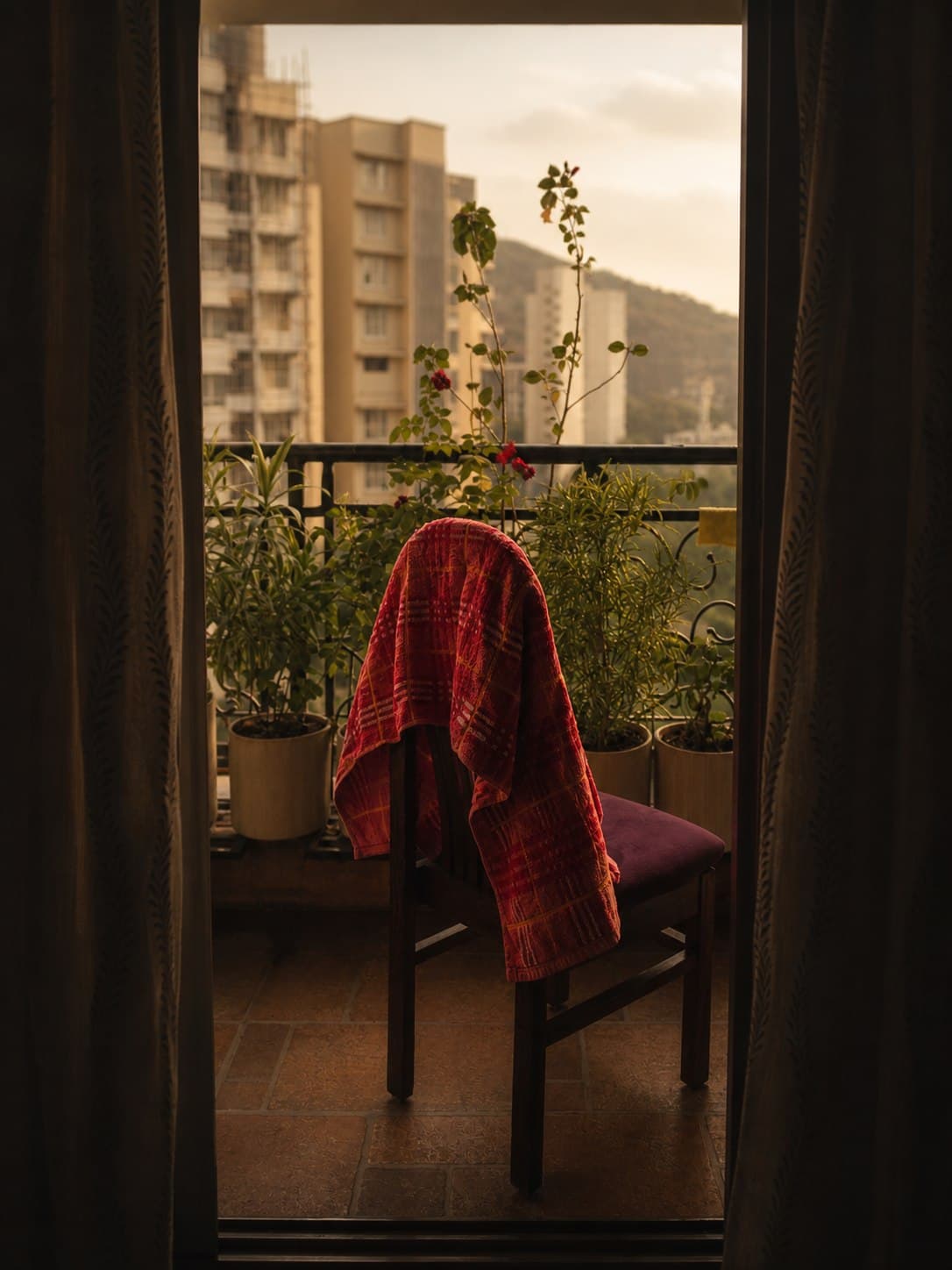
And sometimes staying is how ordinary things become evidence.
Next
Keep reading.
Continue reading
More to read.
Letter Up Above
Some conversations do not end just because the other person is gone. This is a letter to the man whose absence still feels unfinished.
Read Letter Up AboveTransformation Metamorphosis
I disappeared for a while and came back with the usual excuses. Underneath them was a more familiar truth: change was coming, and I was not nearly as brave about it as people like to pretend they are.
Read Transformation MetamorphosisPreordained Partings
Uncle PJ returns to talk about relationships, not just romantic ones, and why some connections arrive already carrying their ending in the fine print. Also, naturally, a brief and completely necessary detour into influencers.
Read Preordained Partings