Essays / Reading River

Keep reading.

A long scroll through the entry points first, then the older pieces.

01Domestic EvidenceMay 20, 20268 min read1410 words

Dirty Laundry

Some objects are not valuable because they are useful. They are valuable because memory needed somewhere to live.

A young man investigates whether his towel is unhygienic, sentimental, or merely a victim of poor succession planning.

I live in a state of continual improvement, which is a polite way of saying that every few weeks I look at one part of my life and wonder whether it has been quietly embarrassing me.

This time, I was looking for the next lifestyle upgrade.

Nothing over the top. Not a scented humidifier. Not a Japanese lamp with a name that sounds like it does breathwork. Just an upgrade of something I actually use. Something ordinary. Something daily. Something that had been participating in my life without asking for recognition.

Then my eyes fell upon my red towel drying on the balcony, hanging on for dear life.

Literally.

It had had its fair share of drying, and it showed. The red had become a tired red. Not vintage. Not faded in a tasteful, coastal-European way. More like a textile that had seen things and chosen silence.

I remembered a friend of mine once mentioning, amused, that he had seen the towel in college.

College was half a decade ago.

I was less embarrassed by the towel than by the fact that his brain had allocated archival space to it. A human mind, capable of love, ambition, memory, pattern recognition, and allegedly higher consciousness, had retained information about my bath linen.

He was right, though. I had been using this towel since college.

In my defence, it was a great towel. Soft enough. Loyal. Absorbent if approached with conviction. It had never given me problems, which is how many household objects enter permanent government service under deeply suspicious conditions.

It was still my favourite towel. I travel often enough to own the other kind: compact, functional, easy to pack, and roughly as kind to skin as sandpaper with ambition. This one was not efficient. It was middle-class luxury. Familiar cotton, proper weight, the kind of ordinary comfort that starts feeling extravagant only after you have tried living without it.

But having a serious interest in skincare should have prevented this hygienic security lapse. A man cannot speak casually about serums and then dry his face with a towel that has survived multiple academic eras.

At some point, nostalgia stops being a feeling and starts becoming a laundering issue.

And yet, throwing it away felt strangely severe.

That was the part that annoyed me. I had set out to buy a towel, not cross-examine the emotional life of household objects. But this is how adulthood gets you. You try to improve one small thing and suddenly a cupboard somewhere clears its throat.

The towel was not the first object in my life to outlive the clean borders of function.

There was also the almirah.

When I was planning my new room, my mother wanted to keep an old almirah there. I did not want it. It was old, bulky, visually inconvenient, and not in the charming antique way.

It was purple. Iron, from a time when furniture was built like it had legal rights. It had dents with lineage. It made a familiar metal complaint whenever opened, a sound the house had stopped hearing because it had become part of the weather. It had a hidden locker whose contents were hidden from absolutely no one.

Like every room that has gone through a middle-aged crisis, it had survived multiple redesigns. Mattresses changed. TVs upgraded. The almirah had grown too, just less dramatically than the rest of us.

It did not belong to the version of the room I had in mind.

I said as much.

My mother, however, was strangely adamant that it should not be thrown away.

This confused me. Normally, she is very capable of identifying objects that have outlived their usefulness, especially when those objects belong to other people. But with this almirah, there was resistance. Immediate, unreasonable, and therefore probably important.

Then she said it was her marriage gift from her parents. She said it half defensively and half proudly.

I instinctively corrected her.

“Your marriage? You mean your and Dad’s marriage.”

Because as a son, that is how I inherit the idea of their marriage. It is a shared family fact. A date. A story. A before-and-after point from which my own life eventually becomes possible.

Dad was there too, the known third listener in the room, present in the quiet way fathers sometimes are when a household object begins making everyone emotional without permission. He was in the kitchen, preparing food for the small republic of dogs he had rescued. His expression belonged to the stew. His attention belonged to our conversation.

But within a minute of correcting her, I realized something uncomfortable.

I had no idea what marriage had meant to my mother as a twenty-five-year-old Indian girl.

Not “mother.” Not “wife.” Not the woman whose taste I had argued with over cupboards and curtains. A twenty-five-year-old girl, entering a new life with objects that were not merely objects. Furniture, clothes, utensils, trunks, cupboards — things that carried hope, fear, adjustment, status, family expectation, private identity, and whatever version of courage marriage demanded from women of that time.

To me, the almirah was old furniture.

To her, it may have been evidence.

This should have ended the argument, but because I am my mother’s son, I continued litigating the matter.

I told her it was exactly like Grandpa’s old army trunks — the ones Grandma refused to part with even though they took up space and, as far as practical storage systems go, were committing several crimes. My mother had wanted those gone too. Grandma would not allow it.

At the time, it looked like stubbornness.

Now, watching my mother defend her almirah, the pattern became less funny.

Every generation thinks the previous one is irrational about objects until its own objects begin carrying time.

That is the problem with things at home. They are never just things for long.

A towel is not just a towel if it has followed you from college to adulthood. An almirah is not just an almirah if it entered a house as part of a young woman’s marriage. An army trunk is not just a trunk if it once belonged to a man whose absence now occupies more space than the trunk ever did.

Objects are not merely their function.

They become domestic evidence.

Evidence that someone lived here. Evidence that someone changed. Evidence that something once mattered enough to be kept even after it became inconvenient. Homes are full of these quiet witnesses, sitting in corners, shelves, cupboards, drawers, pretending to be storage problems.

Which brings me back to the towel.

My red towel was not a marriage gift. It had no army history. No ancestral gravity. No one would accuse it of dignity. It was, at best, a hardworking piece of cloth that had been allowed to remain in service long past its retirement age.

But it had been there.

College bathrooms. Bhimtal winters. Dehradun rains. Mumbai humidity. Every room in between where I was technically becoming a man but still making the same questionable laundry decisions.

It had seen post-gym showers, pre-date showers, sad showers, urgent showers, showers taken out of discipline, showers taken out of despair, and showers where the only thing being washed off was the vague feeling that the day had mishandled me.

It had hung from chairs, doors, balconies, hooks, and occasionally from whatever surface seemed most emotionally available.

It had been packed, unpacked, forgotten, found, reused, defended, and allowed to continue under a regime that confused endurance with hygiene.

It had not seen everything. But it had seen enough.

So I suppose what I am trying to say is that there is a very deep-rooted, primal, evolutionary reason behind my suspicious towel hygiene.

PLEASE STOP ASKING ME TO BUY A NEW TOWEL, OKAY MOM. IT SAW ME GROW UP.

. . . Anyway. I will buy the new towel. I am not insane. There are limits to romance, and many of them are microbial. But before I retire the old one, I took a picture of it in the balcony sun. Not because it is beautiful. Because it stayed.
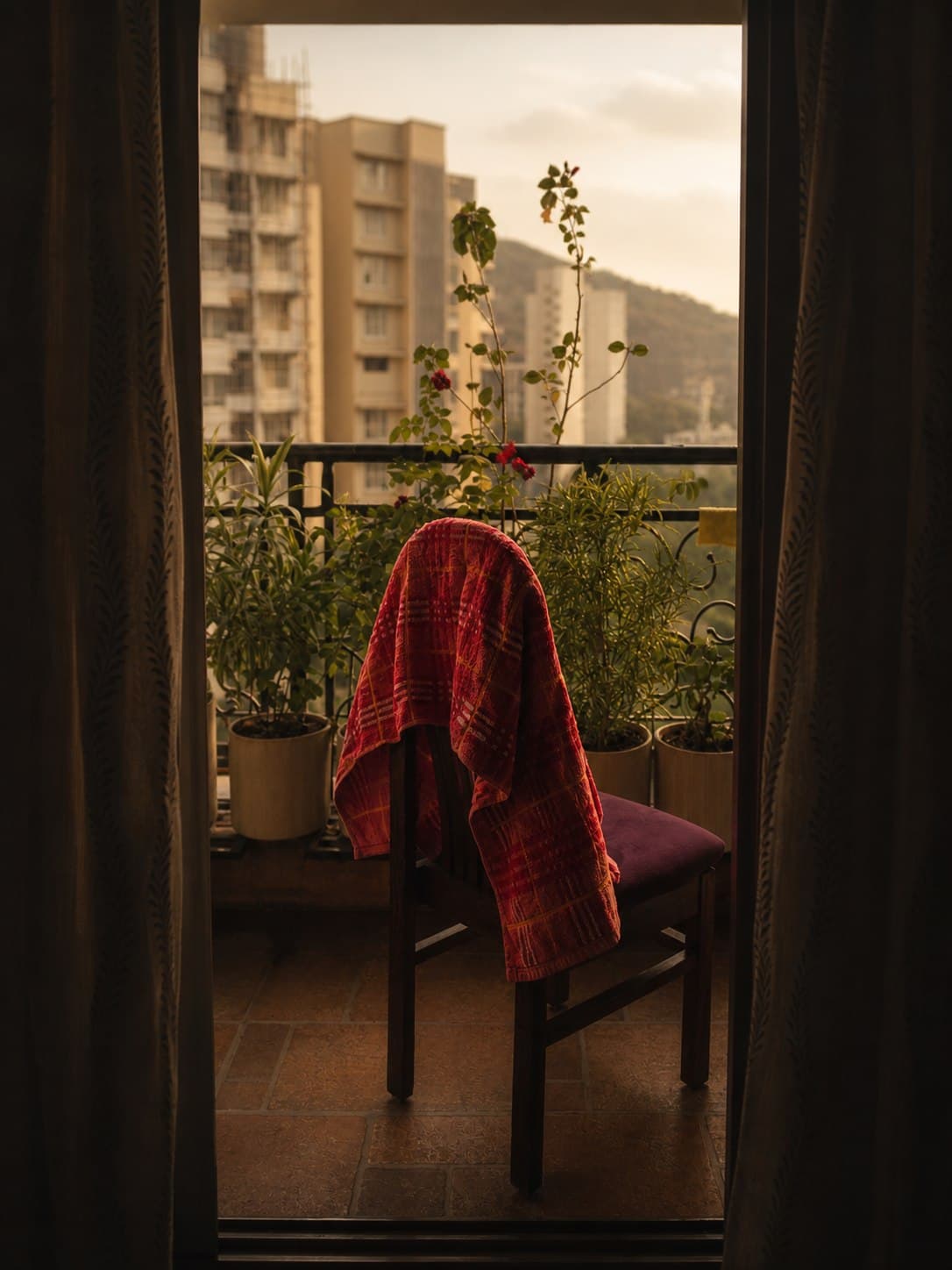
A red towel draped over a chair on a balcony between curtains, with plants, buildings, and hills beyond.
Still in service.

And sometimes staying is how ordinary things become evidence.

02ReflectiveJanuary 25, 20194 min read656 words

Letter Up Above

Some conversations do not end just because the other person is gone. This is a letter to the man whose absence still feels unfinished.

Dear Grandpa,

It is strange how memory works. Out of all the years we had, the one that comes back to me most clearly is the Cricket World Cup final. Dhoni hits the winning six, the room erupts, and your laugh rises above everything else. That is still my favorite memory of you.

I am in college now. If there is one thing I keep thinking about, it is that you did not get to see this part. You did not get to watch me leave home, figure things out, and at least pretend that I know where I am going. I know you wanted me to join the army. I know how much that meant to you. I also know that it was never really my path, no matter how hard I tried to make it fit.

The older I get, the more I understand how difficult your life must have been. When you told me that you had no proper place to live in your twenties, I nodded along as if I understood. I did not. I could not.

Now I think of what you built: a roof over your head, food on the table, and a family that never had to doubt who was holding the center together. You made dependability look ordinary. Only later do we realize how much weight one person had been carrying all along.

Telling you and Dad that I did not want to join the army was one of the hardest things I have done. You never made a big scene about your disappointment, which somehow made it worse. I could see it, even when you refused to show it. And yet, when I failed to get into a good college after school and took a drop year, you did not hold that against me.

Instead, you did what you always did. You quietly stood beside me. You clipped an article from the newspaper for me, something about how to prepare during a drop year. You had this habit of cutting out such pieces for me. I did not appreciate those gestures enough at the time. I mostly glanced at the articles and moved on. But I know now what was really being passed to me. Not the paper. Not the advice. Faith.

For a long time I wondered why I did not cry at your funeral. I cried before that day, when I saw you in a hospital bed and could not reconcile that sight with the man I knew. But when the moment finally came, there were no tears. Just disbelief. Maybe grief is not always loud. Maybe sometimes it is simply the refusal to accept that the world will continue without someone who made it feel anchored.

Even now, a part of me still feels as though I will watch the next World Cup final with you. A part of me still thinks there will be more newspaper clippings, more practical advice, more of that particular silence that says, "I am here, even if I am not saying much."

I wish you could have seen me leave for college. I wish you could have watched me become at least a little more independent. I did not get into the kind of college that would have impressed everyone, but I am doing alright. Better than alright, some days.

I still try to be as disciplined as you were, and I still fall short. But if I have inherited even a fraction of your steadiness, I will count myself lucky. You were the biggest influence of my life. You still are. The next time I write to you, I hope it will be as someone who has built something dependable too. Maybe not with the same grit. Maybe not with the same grace. But honestly enough that you would recognize the effort.

Your loving grandson.

P.S. Grandma gave me your silver Titan watch. I wear it occasionally.

03ReflectiveOctober 29, 20238 min read1433 words

Transformation Metamorphosis

I disappeared for a while and came back with the usual excuses. Underneath them was a more familiar truth: change was coming, and I was not nearly as brave about it as people like to pretend they are.

I had every intention of becoming one of those disciplined writers who say things like, "New post every Friday," and then somehow keep that promise. Instead I disappeared for a while, came back with excuses, and then had the audacity to act mysterious about it.

For the record, the real explanation was much less glamorous.

I was lazy.

Also, life happened.

Also, sometimes "life happened" is just the polished corporate way of saying, "I was lazy."

One thing became obvious during my grand disappearance, though: I miss writing. I miss catching a sentence in the middle of the day and thinking, that is so stupid, I need to use it somewhere. The tragic part is that I almost never write these things down. So by the time I sit down to actually type, I am left with vibes, fragments, and the overwhelming urge to sound profound.

Today I want to talk about change. Not the kind you scrape together at the bottom of your bag. The other kind. The kind that makes even confident people look like nervous interns on their first presentation.

People love saying the same old line whenever change comes up:

Change is inevitable.

What a wonderfully useless sentence.

So is Monday, but you do not see anyone lighting scented candles and saying, "Relax, man, the start of the workweek is actually good for character."

It has been more than two years since I graduated college. I have a decent job, a functioning social life, and a body that occasionally hints at athletic promise if viewed in forgiving lighting. The point is, things are alright. Not perfect. Not movie-worthy. But stable. And stability is dangerous because the moment you get used to it, any disruption starts to feel personal.

Lately I can feel change creeping toward me again. I may have to switch jobs. I may have to switch cities. I may have to walk away from the exact routine I spent so long complaining about and then quietly grew attached to anyway.

That is the sick joke of adulthood. You finally build a life sturdy enough to lean on, and then life says, "Nice. Now let us rearrange the furniture."

The strange part is that I actually like my job. Which is probably why I know I should eventually leave it. I have grown comfortable there, and comfort is not always the same thing as peace. Sometimes comfort is just stagnation with better branding. I used to be hungry to learn. I used to want to be sharper, faster, harder to replace. Now I have become a little too fond of the weekly rhythm: the weekday grind, the Friday drinks, the office gossip, the familiar faces, the same handful of people who keep asking whether you have "bandwidth."

The office, by the way, is just college on steroids.

Your wallet has more muscle. Your free time has less. Your classmates are now called colleagues and pretend not to care about drama, which is hilarious, because office gossip travels faster than campus rumors ever did. You still have presentations you do not want to give, people you do not want to sit next to, and a group of semi-friends you like enough to grab drinks with but probably would not trust to help you move houses. Replace assignments with deliverables, professors with managers, and hostel heartbreak with badly lit rooftop bars, and the overall formula remains suspiciously familiar.

Which is precisely why leaving it all feels so unsettling.

People will tell you that change is beautiful. These people are liars, or worse, optimists.

"Bro, moving to a new city is amazing. It will push you out of your comfort zone."

Shut up.

Being pushed out of your comfort zone is an elegant way of describing emotional whiplash.

Change is awful because it asks for payment upfront. You do not get the wisdom first and the discomfort later. No. First comes the confusion, the uncertainty, the awkward beginning, the loneliness, the "what the hell am I doing?" phase. The lesson arrives much later, acting as if it did not make your life miserable for six months first.

Another reason change feels so brutal is nostalgia. That lunatic never plays fair. Nostalgia is like a filter slapped over your past. It edits out the boredom, the irritation, the repetitive nonsense, the minor embarrassments, and leaves behind a curated highlight reel.

You forget how often you were restless. You forget how often you wanted out. You forget how many nights you spent saying, "I need something different."

Then the moment something different actually appears, you suddenly become the brand ambassador of the life you were just insulting last week.

Routine helps nostalgia run this scam.

Routine is comfort. Routine is knowing which tea stall makes the best tea, which road will get you home faster, which coworker will say something idiotic before lunch, which friend will cancel last minute, which chair in the office is secretly the best one. Routine is not always exciting, but it is deeply efficient. Your brain loves that. Your brain would happily trade adventure for predictability if given the chance.

Which is probably why it also loves reels.

You wake up, open your phone for "just two minutes," and immediately get fed one of two kinds of nonsense.

The first kind is made by someone who is clearly from a different generation and somehow furious at yours. If it is an older person, they are lecturing you about hustle, discipline, or how nobody wants to work anymore. If it is someone younger, they are performing a bit so specific that you can only assume there is a secret council somewhere issuing instructions.

The second kind is worse.

It is made by someone from your own generation who has figured out how to make stupid amounts of money by packaging mediocrity with confidence. That hurts because it is close enough to home to feel insulting. You are brushing your teeth while some guy with a perfect beard and a shock-thumbnail face screams:

I TRIED A BILLIONAIRE MORNING ROUTINE FOR 7 DAYS

THIS SIDE HUSTLE MADE ME MONEY WHILE I SLEPT

I GAVE A RANDOM GUY 100 BUCKS AND CHANGED HIS LIFE

Did you though?

Or did you just discover that the internet will reward any sentence that sounds like a lie, provided it is delivered with enough certainty and a loud enough background track?

Reel culture runs on a painfully simple formula:

  1. Make a dramatic claim.
  2. Say, "Okay, hear me out."
  3. Present unverified nonsense with the confidence of a man announcing the weather.
  4. Add background music that has no business being there.
  5. Collect engagement from people who are either furious or fascinated.

That is not content. That is digital bait with subtitles.

And yes, before you point out the hypocrisy, I know I still watch them. Sometimes I even enjoy them. The algorithm knows me too well now. I watched one video about strength training and for the next week my feed looked like a convention for men who moisturize more than I do. A little alarming. A little educational. Mostly alarming.

But that is exactly the point.

Routine makes nonsense feel familiar, and familiarity feels safe. We rewatch old sitcoms for the same reason. Not because every episode is brilliant, but because we know the beats. We know who says what, who ends up with whom, and which moments are good enough to forgive the rest. Familiarity lowers the stakes. Change raises them.

That is why people say they want a new chapter and then panic the moment they hear the page turn.

So what is the grand conclusion here? Is change secretly amazing? Is discomfort the path to enlightenment? Should we all frolic into uncertainty with bright eyes and motivational music?

Absolutely not.

Change is still awful.

But staying the same out of fear has its own kind of misery. It is quieter, more respectable, and easier to explain to relatives, but it is still misery. You slowly become a perfectly maintained version of someone who has stopped moving.

Maybe that is all we really need to understand: change does not have to feel beautiful to be necessary. You do not need to romanticize it. You do not need to post about it in a scenic caption. You just need enough honesty to admit that it scares you, and enough courage to keep walking anyway.

If leaving hurts, it probably means something mattered.

And if the future terrifies you, it probably still has something to offer.

My inbox is open, as always.

Showing 3 of 24. Scroll for more.